AI Product Operations
Client
GWI
My contribution
Design and build of an an agentic product operations system from scratch, inlcuding opportunity normalising, scoring, research synthesis, reusable skill library and human AI interface.

The problem

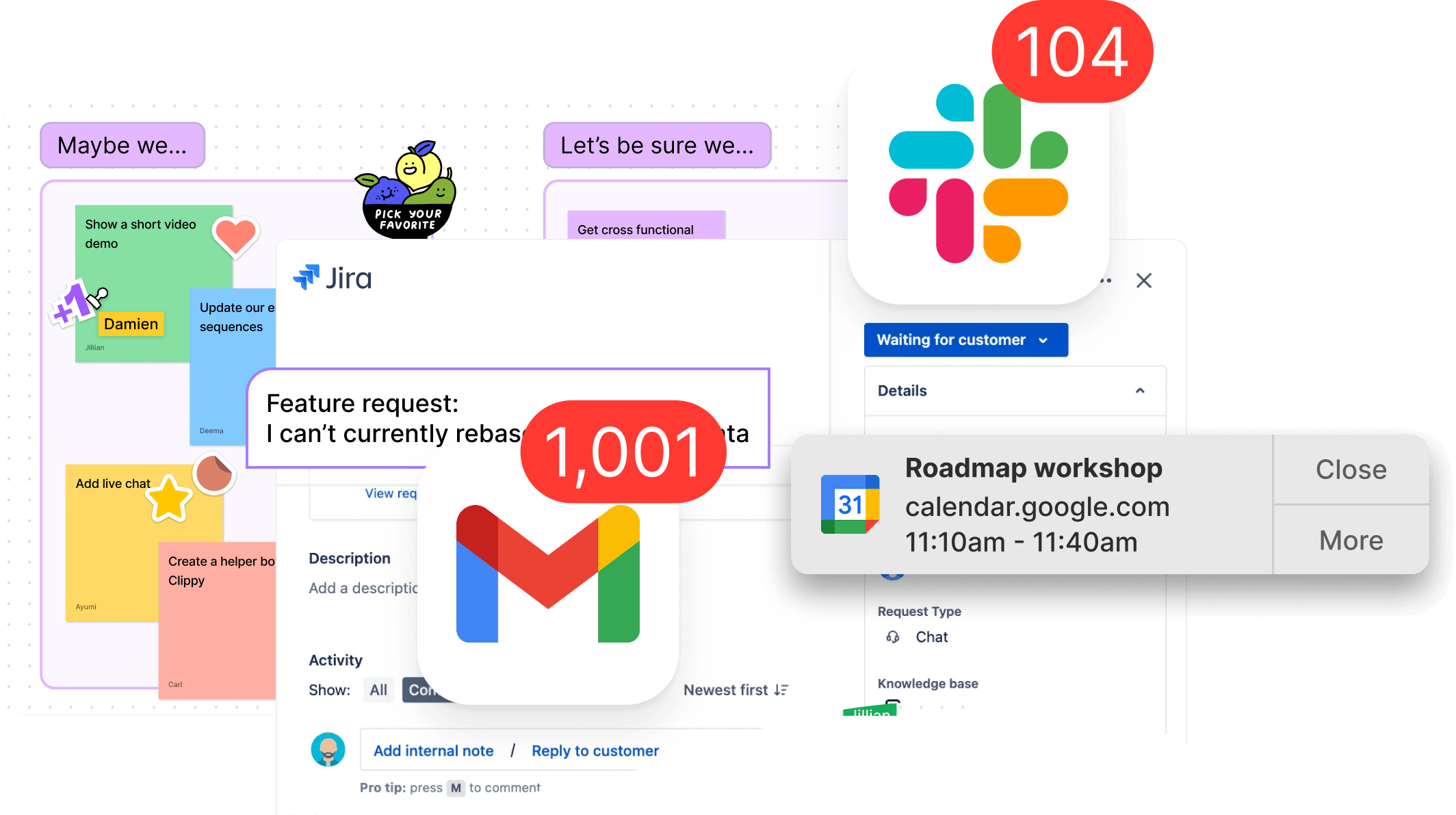
Design and product roles working across multiple teams at speed face a compounding overhead problem. Opportunities arrive from every direction, customer research, analytics, stakeholder asks, strategic initiatives. The work of evaluating, prioritising, and synthesising them aften leaves people buried in too many options, making it hard to focus on any single one.

At GWI, teams worked across four interconnected products with growing backlogs and limited capacity. We needed a way to make the team's operations smarter, not by adding process, but by embedding AI into the workflow itself.
Opportunities arriving from every direction

What I built

An agentic operations system with three layers:

Opportunity scoring
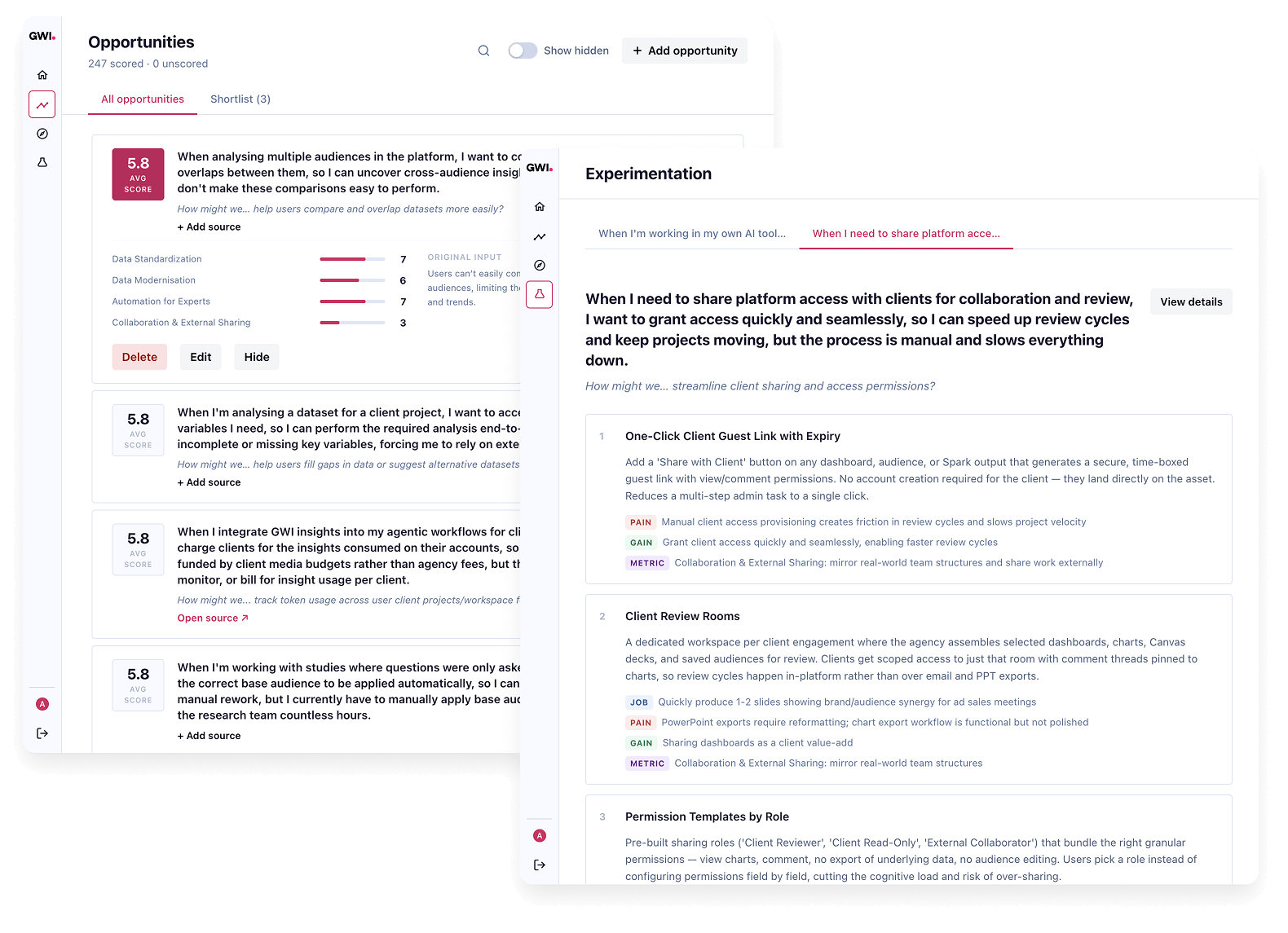
A structured ingest pipeline that captures incoming opportunities from any source, normalises them in comparable problems statements, and scores them automatically against defined business success criteria. Each team using the tool had the flexibility to define their own success measures. The scorer surfaces a ranked list of opportunities, so teams consider the highest scoring opportunities first.

Research synthesis
This agentic skill layeres user research onto business opportunityies by ingesting raw user interview transcripts and existing research, and producing structured JTBD insights through the lense of the opportunities, completed in minutes. Feeding off a knowledgebase of our users, our products and our business, this skill goes deeper into the overlaps of user, business and constraints to fefine viable opportunities.
Tested on real enterprise client sessions (Amazon Ads, Disney, Uber Ads). What previously took days of manual tagging was reduced to minutes.

A reusable skill library
Each capability was designed as a discrete, callable skill. Ingest, score, synthesise a one-page brief so the system could be extended and handed off to the team as shared tooling, not a personal workaround.

Ideation bolstering
Powered by a knowledge base of our products, users and business data, the tool could even generate high-level solution ideas as part of the package, useful to spark inspiration in workshops.
AI built user interface, so anyone can access custome agent skills

The guardrail insight

Running an agentic sprint on enterprise use cases surfaced something that reframed how I think about AI in complex workflows: guardrails aren't about restriction, they're what enables trust.

It was a design decision to mirror our process, and allow the AI outputs to be tracked throughout it. A human could choose to manually take over the workflow at any point, or continue using AI. This level of familiarity, oversight an control demystified the AI aspect and built trust though offering control.

What this demonstrates

Complex multi-person workflows such as this: research, prioritisation, briefing, synthesis, carry high coordination overhead and high knowledge asymmetry. AI can absorb much of that overhead, but only if trust is designed in from the start. Visible reasoning, human override at every step, and uncertainty surfaced rather than papered over.

The most important design decisions in an agentic system aren't about the AI's capability. They're about how humans stay in the loop, how confidence is communicated, and who gets to set the boundaries.
Click highlight to open ico